Description and Project Summary:
Statistical Analysis Using All of Us Research Program Data
Hashimoto’s thyroiditis is an autoimmune disease where the immune system attacks thyroid tissue, often resulting in an underactive thyroid. Although Hashimoto’s can affect anyone, it is much more common in individuals assigned female at birth (AFAB). Research has suggested that sex hormones may play a role in autoimmune disease, but their possible relationship with Hashimoto’s is still not fully understood.
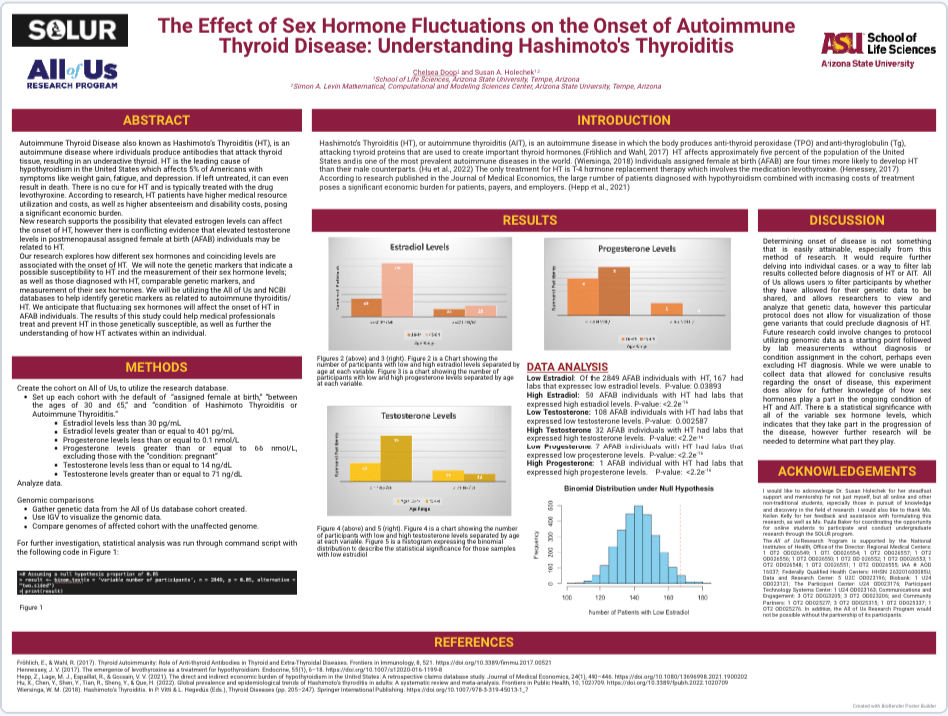
For this project, we explored patterns in estradiol, progesterone, and testosterone levels among AFAB individuals diagnosed with Hashimoto’s thyroiditis or autoimmune thyroiditis.
Methods
We created a cohort of 2,849 AFAB participants between the ages of 30 and 65 using the All of Us Research Program database. Participants were separated into groups based on defined low and high thresholds for estradiol, progesterone, and testosterone.
Using R, I performed two-sided exact binomial tests to compare the proportion of participants in each hormone group with a 5% comparison value. I also summarized the number of participants in each group, calculated p-values, and created figures to show the results.
Results
Of the 2,849 participants:
- 167 had low estradiol levels.
- 50 had high estradiol levels.
- 108 had low testosterone levels.
- 32 had high testosterone levels.
- 7 had low progesterone levels.
- 1 had high progesterone levels.
Low estradiol was the only category that appeared in slightly more than 5% of the cohort. All other low or high hormone categories appeared in less than 5% of participants. The statistical tests showed that the proportion in each group differed from the 5% comparison value.
These findings show patterns within this specific group of participants, but they do not show that hormone levels cause Hashimoto’s thyroiditis or affect its onset.
Limitations and Future Research
This project only included participants who had already been diagnosed with Hashimoto’s thyroiditis or autoimmune thyroiditis. We did not have a matched group of unaffected participants for comparison, and the timing and availability of laboratory results may have differed between participants.
Further research could compare affected and unaffected groups, follow hormone levels over time, and include additional clinical or genetic information. This would help determine whether certain hormone patterns are associated with the development or progression of Hashimoto’s thyroiditis.
My Contribution
As the primary student researcher and author, I helped develop the research question, created and organized the All of Us cohort, performed the statistical analysis in R, created and interpreted the figures, reviewed the scientific literature, and prepared the research poster.
Primary Author:
Chelsea Doop
Completion:
2024
Presented at:
BioSci Symposium October 2023
Faculty Mentor:
Dr. Susan Holecheck

