Description and Abstract:
Bee Watching from 1800 Miles Away
Honeybees play a vital role in every aspect of our ecosystem and research shows that the health and productivity of colonies depend on various factors/environmental conditions. Temperature stress is one factor that may potentially affect productivity.
The queen honeybee demonstrates fluctuating resilience to temperature stress, however, the extent to which she modifies her oviposition rate in response to temperature remains somewhat misunderstood. In this study, we aimed to investigate the effect
of temperature change on the oviposition rate of the queen honeybee. We hypothesized that the queen honeybee exhibits less oviposition when exposed to significant temperature changes. Using remote video footage of a hive of honeybees located
inside a room with air conditioning with a means for outdoor access, we analyzed the queen’s behavioral pattern at different internal and external temperature conditions and measured her oviposition rate under each condition. The data was collected
during the winter season. Results show that temperature changes of ~15-20°F do not significantly affect the queen’s oviposition rate. The queen shows some resiliency, however, a longer testing period is required to consider even greater temperature
changes, seasons, and inclement weather. Understanding the effect of temperature stress on the behavior of the queen has important implications for the health and productivity of honeybee colonies. By identifying how the queen responds, we can
develop strategies to mitigate the potential negative impacts of temperature stress on colonies. Our study contributes to a growing body of knowledge on the adaptive behaviors of honeybees in response to environmental factors.
Authors for Poster/Data Contribution:
Mary Brabentz, Chelsea Doop, Alanna Supon, Jamal Bell, and Kayla Rodriguez
Lab PI:
Dr. Hong Lei
Completion:
April 2023
Manuscript
ENVIRONMENTAL TEMPERATURE FLUCTUATION AND ITS AFFECT ON BEE OVIPOSITION
Primary Author: Chelsea Doop
Contributors: Mary Brabentz, Alanna Supon, Jamal Bell, Kayla Rodriguez
Arizona State University, School of Life Sciences, Tempe, Arizona
Abstract
Bees are an integral part of our environment as important pollinators, both among wild populations and our own crops. Regardless of this fact, bees face many problems within today’s world: threats from pesticides, invasive species, fragmentation and habitat loss, disease, and climate change. It becomes important to learn as much as possible about these insects when several different North American indigenous species are in peril. In light of the rapidly changing climate, it remains imperative to understand how it might affect bee populations and, in the case of this research, their reproductive habits. This study focuses on the queen bee’s ovipositing behaviors with regard to changes in temperature. A remote observation hive of honeybees was kept to allow for around-the-clock viewing with recording equipment kept in place for documentation and long-distance observation. The queen was marked with a bright yellow dot to allow for easy identification in the hive, and ovipositing behavior was analyzed with coinciding temperatures between the months of January to March. While this timeframe showed somewhat of a temperature change with the coming of spring in Arizona, results would be clearer if further research were conducted. Our data did not show much change in ovipositing behavior, however, lack of variation leads to the belief that there is much more data to be collected over a longer time period. These findings can lead to further analysis of the abilities of the queen bee’s fluctuations in egg laying habits during temperature changes.
Introduction
In 2022, the National Oceanic and Atmospheric Administration reported that it was the sixth warmest year on record, with the Earth’s surface temperature averaging 1.55°F warmer than the last century. The entirety of the world, with the exception of only a few locations, has seen a significant change in the last 20 years. (Lindsey & Dahlmen, 2023) Meanwhile, honeybees are the most frequent floral visitor of crops worldwide, and they are the sole visitor of 4% of recorded plant species. (Hung et al., 2018) According to the USDA-National Agricultural Statistics Service, honeybees pollinate $15 billion worth of crops in the United States alone and produce $3.2 million of honey harvested for human consumption. (USDA, n.d.) Based on the aforementioned statistics, honeybees maintain an integral space in human economics and global ecosystems. Some research has shown that changes in weather affects honeybee activity (Karbassioon et al., 2023), while others show that temperature stress shows no significant effect on queen honeybee behaviors. (McAfee, 2021) In this study, we focus on the possible changes in queen honeybee oviposition rates. An observation hive was set up along with cameras for recording purposes. During this time, egg laying behaviors and their corresponding temperatures were recorded and analyzed. Our findings were inconclusive with temperatures ranging from 29°F to 70°F, as queen bee oviposition did not vary within this time frame, leading to the belief that there is more information to be gathered from further observation.
Methods and Materials
The Hive
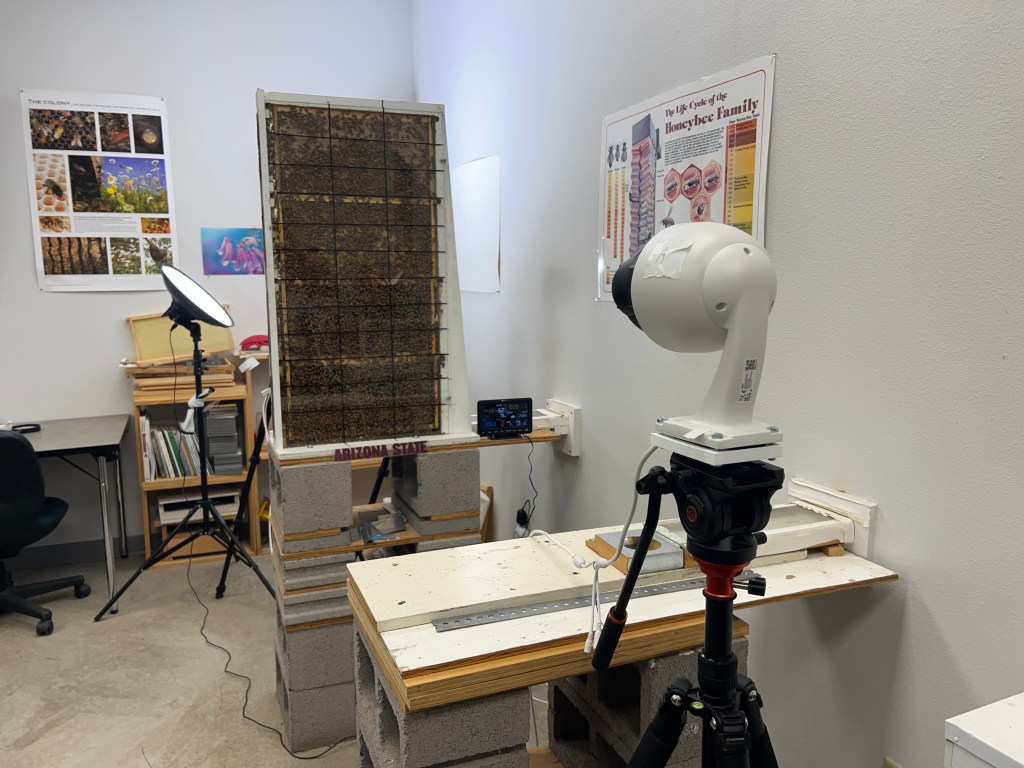
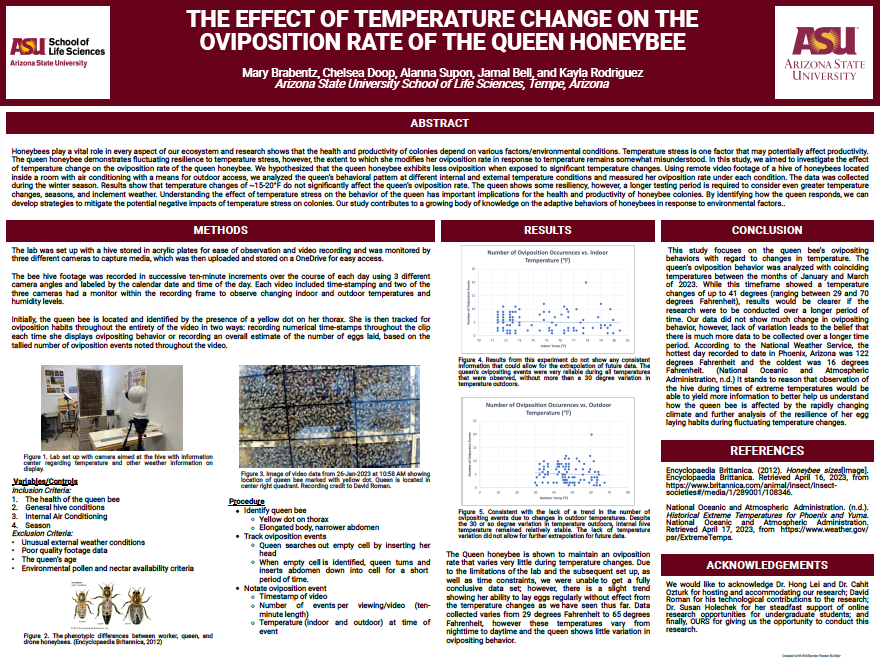
The Bee Annex at Arizona State University’s Polytechnic campus houses the observation hive which is constructed of four 9 and 1/8 inch long by 19 inch wide pine wood frames stacked on top of each other with combs facing outward, covered with acrylic plates to allow for easy viewing and recording. The four story observation hive utilizes a tunnel at the bottom of the hive, connecting it to the outside of the building. Our hive is populated by honey bees, commonly known as Italian bees, or Apis mellifera ligustica. For the purposes of this experiment, the queen bee has been marked by a yellow dot on her back.
Bee Behavior
The queen bee exhibits a specific behavior that allows observers to know when she is ovipositing. She inserts her head into a honeycomb cell in an investigative manner, and if she is satisfied with her findings, she turns to insert her abdomen into the cell and maintains her position for a short while before extracting herself and continuing her search for another unoccupied cell.
Data Collection
The hive is monitored with recording equipment to allow for ease of observation by distance learning researchers. The ReoLink RLC-823A camera of Shenzhen Technology Co., Ltd. is used to record the media which is then stored on a Synology NAS disk station then transferred to a Microsoft OneDrive account for future viewing purposes.
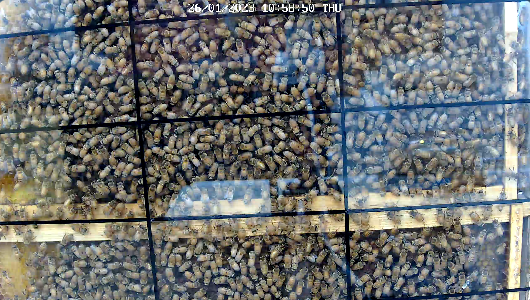
To determine how temperature effects the honeybee queen’s oviposition, time of day is recorded, the temperature inside of the room as well as outdoor temperature, and the number of eggs estimated to have been laid during the video. Weather, wind speed, and humidity both indoor and outdoor is also recorded as possible variables for consideration. Our data was collected from video footage of the hive between the dates of January 9, 2023 to March 6, 2023 at various times throughout the day, depending upon whether the queen was visible on the frame.
Results
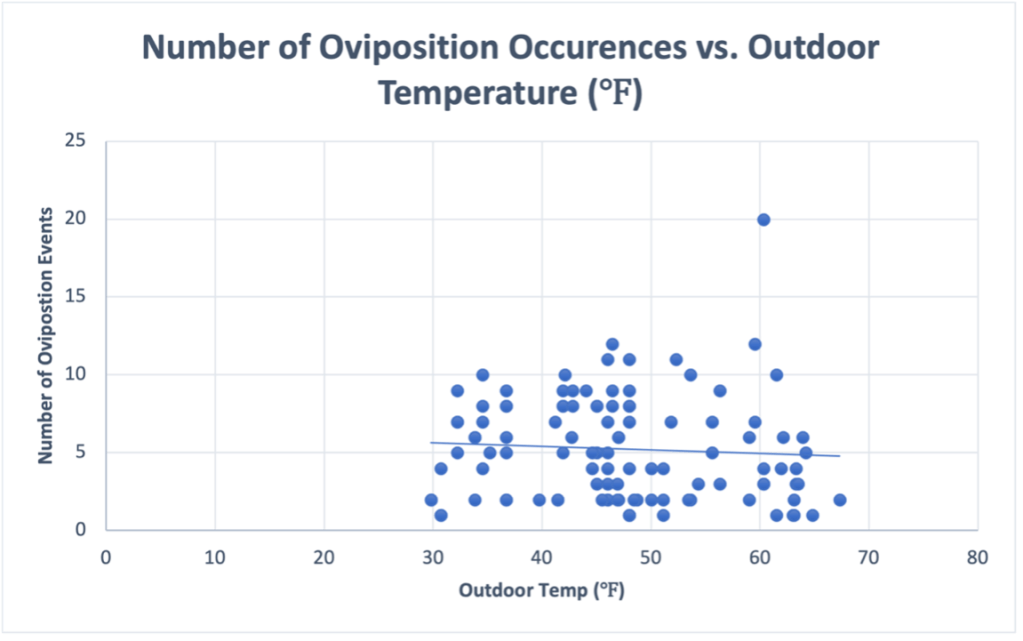
The Queen honeybee is shown to maintain an oviposition rate that varies very little during mild temperature changes. Due to the limitations of the lab and the subsequent set up, as well as time constraints, we were unable to get a fully conclusive data set; however, as can be seen in Figures 2 and 3, there is a slight trend showing her ability to lay eggs regularly without effect from the temperature changes as we have seen thus far. Data collected varies from 29°F to 70°F, at random time intervals. The queen averaged approximately 5 oviposition events over the 41°F difference and shows little change in ovipositing behavior during this time. This lack of variation leads to the belief that there is much more data to be collected over a longer time period.

Discussion
This study focuses on the queen bee’s ovipositing behaviors with regard to changes in temperature. The queen’s oviposition behavior was analyzed with coinciding temperatures between the months of January and March of 2023. While this timeframe shows a temperature change of up to 41°F (ranging between 29°F and 70°F), results would be more conclusive if the research were conducted over a longer period of time. Our data did not show much change in ovipositing behavior, however, lack of variation leads to the belief that there is much more data to be collected. According to the National Weather Service, the hottest day recorded to date in Phoenix, Arizona was 122°F and the coldest was 16°F. (National Oceanic and Atmospheric Administration, n.d.) It stands to reason that observation of the hive during times of extreme temperatures would be able to yield more information to better help us understand how the queen bee is affected by the rapidly changing climate and further analysis of the resilience of her egg laying habits during fluctuating temperature changes.
The lab set up was conducive to the use of multiple experiments, specifically constructed for easy observation and to facilitate remote research. For the opportunity to extend the range of this specific research, an alternate set up would benefit the observer with more cameras, allowing close up footage of each honey comb frame. This would remove the gaps in the data that occurred because of the times when the queen was out of frame in a different part of the hive. In the case of an experiment such as this, the criteria for data would be further expanded to consider humidity and inclement weather, providing further insight to the climate specific environmental effects on the queen honeybee’s oviposition rate.
References
Hung, Keng-Lou James, Kingston, Jennifer M., Albrecht, Matthias, Holway, David A. and Kohn, Joshua R. (2018) The worldwide importance of honey bees as pollinators in natural habitatsProc. R. Soc. B.2852017214020172140. http://doi.org/10.1098/rspb.2017.2140
Karbassioon, A., Yearlsey, J., Dirilgen, T. et al. Responses in honeybee and bumblebee activity to changes in weather conditions. Oecologia 201, 689–701 (2023). https://doi.org/10.1007/s00442-023-05332-x
Li X, Ma W, Shen J, Long D, Feng Y, et al. (2019) Tolerance and response of two honeybee species Apis cerana and Apis mellifera to high temperature and relative humidity. PLOS ONE 14(6): e0217921. https://doi.org/10.1371/journal.pone.0217921
Lindsey, R., & Dahlman, L. (2023, January 18). Climate Change: Global Temperature. Climate.gov. Retrieved April 17, 2023, from https://www.climate.gov/news-features/understanding-climate/climate-change-global-temperature#:~:text=2022%20was%20the%20sixth%2Dwarmest,period%20(1880%2D1900).
McAfee A, Tarpy DR, Foster LJ (2021) Queen honey bees exhibit variable resilience to temperature stress. PLOS ONE 16(8): e0255381. https://doi.org/10.1371/journal.pone.0255381
U.S. Department of Agriculture (n.d.). Honey Bees. USDA. Retrieved April 17, 2023, from https://www.usda.gov/peoples-garden/pollinators/honey-bees
National Oceanic and Atmospheric Administration. (n.d.). Historical Extreme Temperatures for Phoenix and Yuma. National Oceanic and Atmospheric Administration. Retrieved April 17, 2023, from https://www.weather.gov/psr/ExtremeTemps.
Acknowledgements
We would like to acknowledge Dr. Hong Lei and Dr. Cahit Ozturk for hosting and accommodating our research as online remote student researchers; David Roman for his technological contributions; Dr. Susan Holechek for her steadfast support of online research opportunities for undergraduate students; and finally, the Online Undergraduate Research Scholars program for providing the funding that allowed us to conduct this research.
 Chelsea Doop