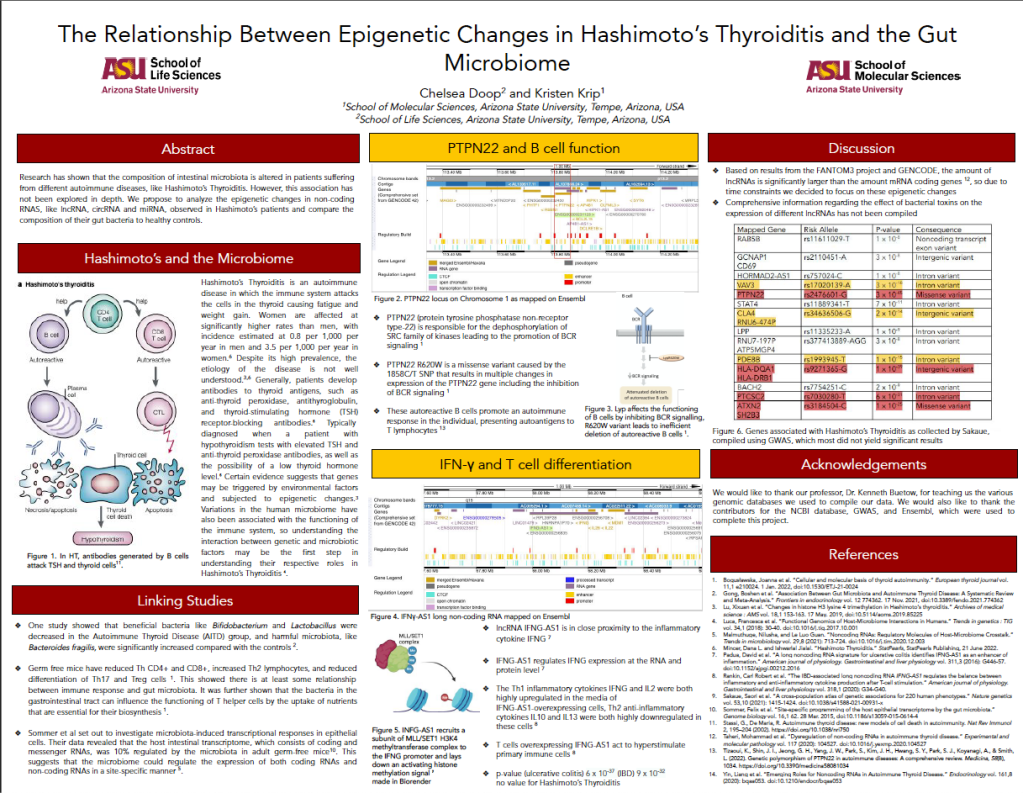
Description and Abstract:
Functional Genomics
Research has shown that the composition of intestinal microbiota is altered in patients suffering from different autoimmune diseases, like Hashimoto’s Thyroiditis. However, this association has not been explored in depth. We propose to analyze the epigenetic changes in non-coding RNAS, like lncRNA, circRNA and miRNA, observed in Hashimoto’s patients and compare the composition of their gut bacteria to healthy controls.
Authors:
Chelsea Doop and Kristen Krip
Instructor:
Dr. Kenneth Buetow
Assignment Completed:
November 2022
Manuscript
The Relationship Between Epigenetic Changes Driven by Microbiome and the Development of Hashimoto’s Thyroiditis
Chelsea Doop and Kristen Krip
Abstract/Summary:
Research has shown that the composition of intestinal microbiota is altered in patients suffering from different autoimmune diseases, like Hashimoto’s Thyroiditis. However, this association has not been explored in depth. We propose to analyze the epigenetic changes in non-coding RNAS, like lncRNA, circRNA and miRNA, observed in Hashimoto’s patients and compare the composition of their gut bacteria to healthy controls.
Background:
● Hashimoto’s Thyroiditis is an autoimmune disease in which the immune system attacks the thyroid.
○ Despite its high prevalence, the pathogenesis and etiology of the disease is not understood. Evidence points to certain genes which may be triggered by environmental factors and epigenetic changes (Lu)
● Mechanisms involved in epigenetic regulation of gene expression include DNA methylation, histone modification (acetylation, methylation, phosphorylation and ubiquitination) and non-coding RNAs. (Lu)
○ Micro RNAs (miRNAs) are small, noncoding, highly conserved ribonucleic acids (RNAs) that regulate gene expression by binding to messenger RNA (mRNA), thus modifying transcriptional processes. A single miRNA can regulate the expression of multiple genes and their encoded proteins [6]. (Trummer)
○ For the first time in history, Sommer and colleagues [18] revealed that the host intestinal transcriptome (coding/messenger RNAs) was partially (10%) regulated by the microbiota in adult germ-free mice, and this regulation was highly specific to the intestinal region. Similarly, site-specific microbial regulation of the expression of lncRNAs in the intestine has also been reported recently in adult mice [19], suggesting that the microbiome could regulate the expression of both coding RNAs (Malmuthuge)
● Variation in the microbiome has also been associated with many human diseases and health conditions, such as inflammatory bowel disease (Crohn’s disease and ulcerative colitis), type 2 diabetes, colorectal cancer, in addition to many others [13–17]. Interestingly, many of the diseases that are linked to the microbiome are also controlled by host genetic factors, as has been characterized by more than a decade of genome wide association studies (GWAS). Since both host genetics and the microbiome can affect host traits, understanding the interaction between these two factors is the first step in uncovering their respective roles in disease. (Luca)
● Beneficial bacteria like Bifidobacterium and Lactobacillus were decreased in the AITD group, and harmful microbiota like Bacteroides fragilis was significantly increased compared with the controls.
○ Firmicutes HT: 48.3% control: 55.1%
○ Bacteriodetes HT: 41.4% control: 55.1%
○ Bacteroides HT: 16.4% control: 14.5%
○ Lachnospiraceae HT: 24.3% control: 17.8% (Gong)
Methods:
Using – Ensembl – for lncRNA sequence information
Gene Expression Omnibus (GEO) Database
To search lncRNA downregulated in AITD patients:
T372371, T330971, T316625, NR_110783, ENST00000443123, NR_110653, T341829, NR_001589, T001580, T001580, ENST00000528497, ENST00000606457, T171326, T212725, T212725, T372712, T343703, ENST00000580937, ENST00000511064, NR_109931 (Taheri)
Yin (see reference) also includes a list of miRNAs T-Cell Metabolic Reprogramming During Autoimmune Thyroid Diseases, which we will investigate.
Expression Atlas (gene expression across species and biological conditions) may prove to be a useful tool; we are still exploring its usefulness.
Results:
We expect to see a correlation between certain populations of microbiota and the expression of lncRNAs and miRNAs usually associated with Hashimoto’s Thyroiditis.
Future Directions:
To incorporate the hormonal element, since these diseases predominantly affect women. Does estrogen have an effect on microbiota composition?
References:
Gong, Boshen et al. “Association Between Gut Microbiota and Autoimmune Thyroid Disease: A
Systematic Review and Meta-Analysis.” Frontiers in endocrinology vol. 12 774362. 17 Nov. 2021,
doi:10.3389/fendo.2021.774362
Lu, Xixuan et al. “Changes in histone H3 lysine 4 trimethylation in Hashimoto’s thyroiditis.” Archives of
medical science : AMS vol. 18,1 153-163. 17 May. 2019, doi:10.5114/aoms.2019.85225
Luca, Francesca et al. “Functional Genomics of Host-Microbiome Interactions in Humans.” Trends in
genetics : TIG vol. 34,1 (2018): 30-40. doi:10.1016/j.tig.2017.10.001
Malmuthuge, Nilusha, and Le Luo Guan. “Noncoding RNAs: Regulatory Molecules of Host-Microbiome
Crosstalk.” Trends in microbiology vol. 29,8 (2021): 713-724. doi:10.1016/j.tim.2020.12.003
Taheri, Mohammad et al. “Dysregulation of non-coding RNAs in autoimmune thyroid disease.”
Experimental and molecular pathology vol. 117 (2020): 104527. doi:10.1016/j.yexmp.2020.104527
Trummer, Olivia et al. “Expression Profiles of miR-22-5p and miR-142-3p Indicate Hashimoto’s Disease
and Are related to Thyroid Antibodies.” Genes vol. 13,2 171. 19 Jan. 2022, doi:10.3390/genes13020171
Yin, Liang et al. “Emerging Roles for Noncoding RNAs in Autoimmune Thyroid Disease.” Endocrinology
vol. 161,8 (2020): bqaa053. doi:10.1210/endocr/bqaa053
 Chelsea Doop